







A1. The job was offered to Paul. (2.)
A2. Three thousand people are employed by this company. (2.)
A3. The window must be left open.
A4. I was walking along the street one day when I met Paul.
A5. I have been wearing a suit and a tie recently.
A6. Peter usually plays tennis on Sundays but he didn't play last Sunday.
A7. She asked me when I had to go to work.
A8. The policemen asked them if they had heard anything.
A1. Your order will be brought in a moment.
A2. The words "to be or not to be" were spoken by Hamlet.
A3. He said that he had studied at Eton in the 70s.
A4. I thought the performance would be interesting...
A5. They said they were going to London soon.
A6. The Guinness Book of Records was first published in the 50s.
A7. I was given a nice present for my last birthday.
1) did
2) Did Ann go
3) visited
4) didn't play
5) wasn't
6) When did you buy?
7) didn't bake
8) ran
9) Did you phone
10) didn't eat
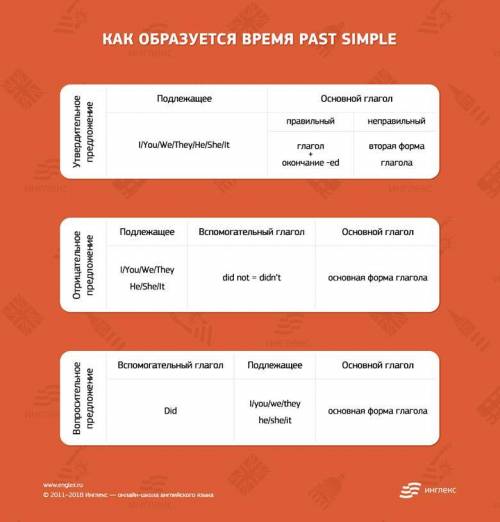
Past Simple выучить легко:Утвердительное предложение
I, you, we, they, he, she, it +  /
/
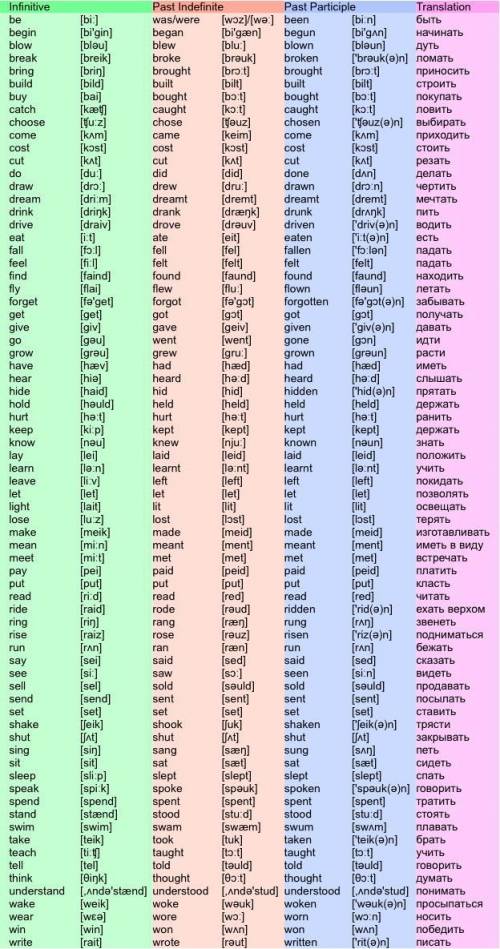
После субъекта ставим глагол в его форме в времени: если он правильный, добавляем окончание -ed (I love - loved); если неправильный, смотрим в таблицу неправильных глаголов (см. второе фото), ищём второй столбец и заодно запоминаем форму (I buy - I bought). Лицо не имеет значения.
Отрицательное предложение
I, you, we, they, he, she, it + didn't + 
После субъекта ставим вс глагол didn't, после этого - главный глагол в его БАЗОВОЙ ФОРМЕ (инфинитив, но без частицы 'to') (I didn't buy, I didn't love). Лицо также не имеет значения.
Вопросительное предложение
Did + I, you, we, they, he, she, it + ?
Сначала ставим вс глагол did (или didn't, если предложение вопросительно-отрицательное), дальше - субъект, а дальше - главный глагол в его БАЗОВОЙ ФОРМЕ (Did I buy?, Did I love?). Лицо также не имеет значения.