








kraine is a sovereign state with its territory, high and local bodies of state power (the supreme council and local councils), government, national emblem, state flag and anthem. the form of governing is presidential republic.
president is the head of the state. he is also the head of the executive branch of power. president is elected by the people of the country at a general election for a period of 5 years. he can’t be elected for more than 3 terms. according to the laws of ukraine a president can’t be younger than 35 years old, he must live in the country no less than 10 years, be a citizen of ukraine and master the national language.
the legislative power is carried out by the parliament (or supreme council) which consists of 450 members. the laws of the country are made by them.
executive power is carried out by the government or the cabinet of ministers, which is responsible for the realization of laws adopted by the supreme council.
judicial power is performed by the system of courts, the highest of them is the supreme court.
beside the organs of power, political system of ukraine also includes political parties and social organizations.
the national symbols of ukraine are the national flag, the national emblem and the national anthem.
the ukrainian flag consists of two horizontal stripes: the upper one is blue and the lower one is yellow. these are the colours of sky, sun, streams and golden fields.
the national emblem is a trident. it symbolizes three elements of the world: air, water and earth.
the music to ukrainian anthem was composed by m. verbytsky.
the policy of new ukraine is one of peace with all her neighbours. to be respected we should be strong and rich; we should be wise, so that everybody will seek cooperation with us; we should be free so that others will follow our example.
4)
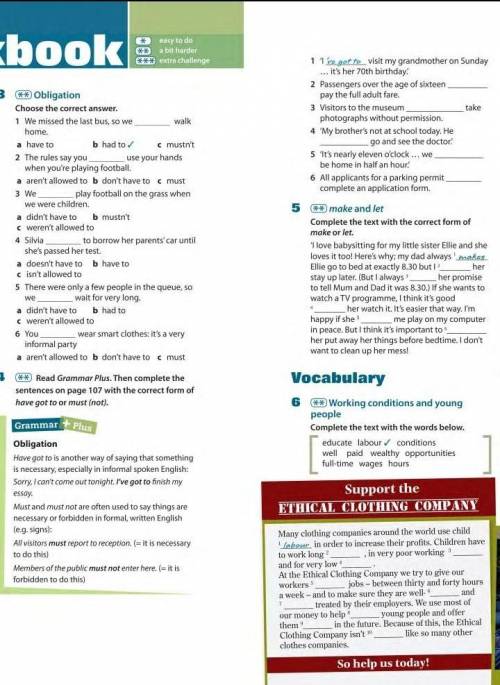
1. I've only got a little money. Can you lend me some?
У меня только немного денег. Одолжишь мне немного? (a little (мало/немного) с неисчисляемым)
2. There isn't much food in the fridge.
В холодильнике мало еды. (much (много) с неисчисляемым)
3. We eat a lot of pasta - it's our favourite food.
(В утвердительных говорят a lot of (много))
4. How much time have you got?
Сколько у тебя времени? (much (много) с неисчисляемым)
5. I've only got a few minutes.
У меня всего несколько минут. (a few (мало/немного) с исчисляемым)
6. There weren't many people on the bus.
В автобусе было мало людей. (many (много) с исчисляемым)
7. Sugar is bad for you, but a little in your diet is OK.
Сахар вреден для тебя, но немного в диете это нормально. (a little (мало/немного) с неисчисляемым)
8. There's not enough food for nine billion people.
Еды не хватит на 9 миллиардов человек. (достаточно/хватит)
5)
1. You haven't bought more chocolate, have you?
Ты не купил больше шоколада, не так ли?
(в предложение вспомагательный глагол в отрицательной форме (haven't), значит "хвостик" будет в утвердительной (have))
2. They love spend money, don’t they?
Они любят тратить деньги, не так ли?
(в предложение смысловой глагол в утвердительной форме (love), раз здесь нет вс глагол, то для "хвостика" используем вс глагол (do) в отрицательной форме (don't))
3. You can't lend me ten euros, can you?
Вы не можете одолжить мне 10 евро, не так ли?
(в предложение модальный глагол стоит в отрицательной форме (can't), значит "хвостик" будет в утвердительной форме (can))
4. You didn't throw the bottles away, did you?
Ты же не выбросил бутылки, не так ли? (в предложение вспомагательный глагол в отрицательной форме (didn't), значит "хвостик" будет в утвердительной (did))
5. You won't be late again, will you?
Ты ведь не опоздаешь снова, не так ли?
(в предложение вспомагательный глагол в отрицательной форме (won't), значит "хвостик" будет в утвердительной (will))
6. The house doesn't have solar panels, does it?
В доме нет солнечных батарей, не так ли?
(в предложение вспомагательный глагол в отрицательной форме (doesn't), значит "хвостик" будет в утвердительной (does))
Объяснение:
Much и Many чаще используют в отрицательных и вопросительных предложениях. А в утвердительных говорят a lot of.
Many для вещей, которые можно посчитать: many friends, many problems.
Much для неисчисляемых существительных: much money, much time.
A little мы используем с неисчисляемыми существительными: (a) little time, (a) little money, (a) little food и т.д.
А few ставим с исчисляемыми: (a) few problems, (a) few days, (a) few books и т.д.
Как-то так