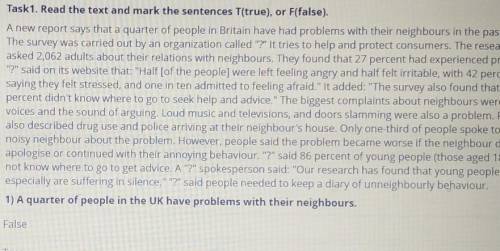
Task1. Read the text and mark the sentences T(true), or F(false). A new report says that a quarter of people in Britain have had problems with their neighbours in the past year. The survey was carried out by an organization called "y" It tries to help and protect consumers. The researchers asked 2,062 adults about their relations with neighbours. They found that 27 percent had experienced problems, "?" said on its website that: "Half [of the people were left feeling angry and half felt irritable, with 42 percent saying they felt stressed, and one in ten admitted to feeling afraid." It added: "The survey also found that 64 percent didn't know where to go to seek help and advice" The biggest complaints about neighbours were loud voices and the sound of arguing, Loud music and televisions, and doors slamming were also a problem. People also described drug use and police arriving at their neighbour's house, Only one-third of people spoke to the noisy neighbour about the problem. However, people said the problem became worse if the neighbour did not apologise or continued with their annoying behaviour, "?" said 86 percent of young people (those aged 18-24) did not know where to go to get advice. A "?" spokesperson said: "Our research has found that young people especially are suffering in silence" "?" said people needed to keep a diary of unneighbourly behaviour, 1) A quarter of people in the UK have problems with their neighbours, True
Mr and Mrs Gray live in a big city, and they have a son. His name is Pete. Pete doesn't like washing. Оne day Mrs Gray said, "I like to live in the country with Рete next summer." So they found a small house in the country and took Pete there for a vacation. When they arrived at the house, Mrs Gray said to Pete, "We will stay here for two weeks." The boy ran into the house and fell down on the floor. He hurt his leg but ran further looked in the rooms. When he came back, he threw his ball up and cried, "Mum! I can't see a bath. Where is it?" "This is a very small house," his mother answered."There is no baths here." got really happy. "This will be a very nice holiday indeed, Mam," he said.
2. Поставьте глаголы в скобках в настоящем или будущем простом. Мистер и миссис Грей жили в большом городе, и они (есть) сын. Имя его (будет) Пит. Пит (не нравится) (мыть). Однажды миссис Грей сказал: "я (люблю) (видео) в стране с Питом следующим летом". Так они (найти) небольшой дом в стране и (взять) Пит туда отдыхать. Когда они (прибыть) в доме, миссис Грей сказал Пит, "мы (остаться) здесь две недели." Мальчик (работать) в дом и (падать) вниз на пол. Он (болят) ноги, но (выполнения) далее (смотри) в номерах. Когда он (приехать) обратно, он (бросать) мяч вверх и (крик), "мама! Я (не могу) (см.) ванна. Где (будет) это?" "Это (быть) очень маленький дом," его мать ответила."Там (быть) здесь нет бани". (вам) очень рад. "Это (быть) очень хороший праздник, действительно, мэм," сказал он.
0,0(0 оценок)
Полный доступ
Позволит учиться лучше и быстрее. Неограниченный доступ к базе и ответам от экспертов и ai-bota
Оформи подписку