








sashademidova12345
20.11.2020 05:06

SUMMATIVE ASSESSMENT FOR TERM 4 Learning objectives
6.4.2.1 (6.R2) Understand independently specific information and
detail in short, simple texts on a limited range of general and
6.5.6.1 (6.W6) Link, with minimal support, sentences into coherent paragraphs using basic connectors on a growing range of familiar general topics
Assessment criteria
• Identify particular facts and parts in reading passage
• Read and discuss about cultural diversity

Level of thinking skills
Application
Higher order of thinking

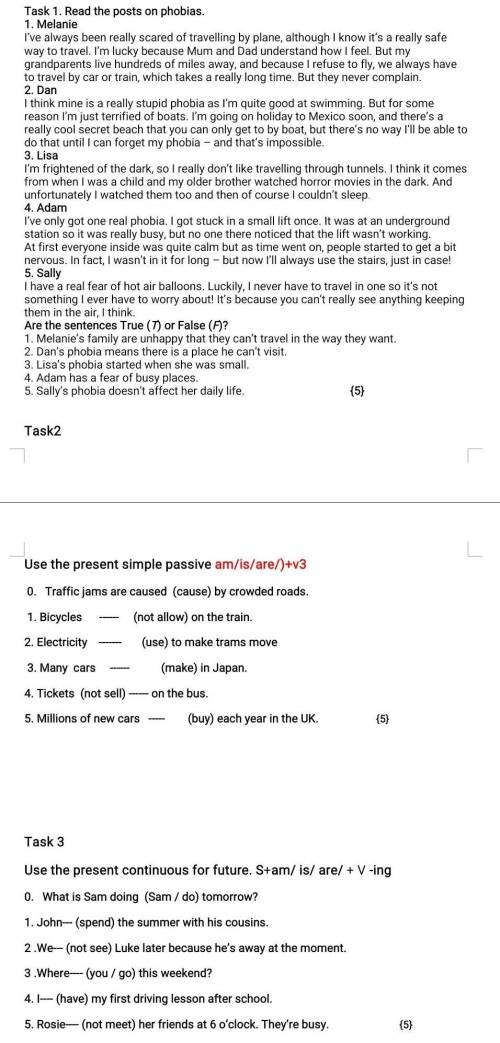
Task 1. Read the posts on phobias.
1. Melanie
I’ve always been really scared of travelling by plane, although I know it’s a really safe way to travel. I’m lucky because Mum and Dad understand how I feel. But my grandparents live hundreds of miles away, and because I refuse to fly, we always have to travel by car or train, which takes a really long time. But they never complain.
2. Dan
I think mine is a really stupid phobia as I’m quite good at swimming. But for some reason I’m just terrified of boats. I’m going on holiday to Mexico soon, and there’s a really cool secret beach that you can only get to by boat, but there’s no way I’ll be able to do that until I can forget my phobia – and that’s impossible.
3. Lisa
I’m frightened of the dark, so I really don’t like travelling through tunnels. I think it comes from when I was a child and my older brother watched horror movies in the dark. And unfortunately I watched them too and then of course I couldn’t sleep.
4. Adam
I’ve only got one real phobia. I got stuck in a small lift once. It was at an underground station so it was really busy, but no one there noticed that the lift wasn’t working.
At first everyone inside was quite calm but as time went on, people started to get a bit nervous. In fact, I wasn’t in it for long – but now I’ll always use the stairs, just in case!
5. Sally
I have a real fear of hot air balloons. Luckily, I never have to travel in one so it’s not something I ever have to worry about! It’s because you can’t really see anything keeping them in the air, I think.
Are the sentences True (T) or False (F)?
1. Melanie’s family are unhappy that they can’t travel in the way they want.
2. Dan’s phobia means there is a place he can’t visit.
3. Lisa’s phobia started when she was small.
4. Adam has a fear of busy places.
5. Sally’s phobia doesn’t affect her daily life. {5}

Task2
Use the present simple passive am/is/are/)+v3
0. Traffic jams are caused (cause) by crowded roads.
1. Bicycles (not allow) on the train.
2. Electricity (use) to make trams move
3. Many cars (make) in Japan.
4. Tickets (not sell) on the bus.
5. Millions of new cars (buy) each year in the UK. {5}

Task 3
Use the present continuous for future. S+am/ is/ are/ + V -ing
0. What is Sam doing (Sam / do) tomorrow?
1. John--- (spend) the summer with his cousins.
2 .We--- (not see) Luke later because he’s away at the moment.
3 .Where (you / go) this weekend?
4. I (have) my first driving lesson after school.
5. Rosie (not meet) her friends at 6 o’clock. They’re busy. {5}


SUMMATIVE ASSESSMENT FOR TERM 4 Learning objectives6.4.2.1 (6.R2) Understand independently specific

Нажмите на рекламу ниже и сразу увидите ответ
Популярные вопросы:
Ответ:
настя14о
15.01.2020 03:15

A term that not every adult knows is easy to decipher. Graphic organizers are everything that helps to organize information on paper or monitor. So simple tables are their variety. Children should learn all this not only in order to be able to work with information, but also in order to apply it immediately. This makes it much easier to remember the material. Inna Bolshakova, an author and trainer of the retraining program for primary school teachers and a methodologist at the Novopechersk School, shared with the participants of the Teachers of the Future festival in Lviv how to teach students to be graphic organizers.

Объяснение:

0,0(0 оценок)
Ответ:
selman20061
04.03.2021 15:03

Rugby - an Olympic contact team sport, the purpose of which is to perform effective actions, namely the defeat of the opponent's goal or bringing the ball into the opponent's scoring zone. Unlike football, rugby is allowed to touch the ball.

The rugby match consists of two halves of 40 minutes each with a break of 5-10 minutes. After the break, the teams must change the goal. If the result of the match is equal, then additional time is assigned - 2 halves of 10 minutes.15 people from each team play on the field at the same time, of which 8 are forwards and 7 are defenders. Based on the results of the draw, the team that will bring the ball into the game first is determined. The ball is kicked into the game.The winner of a rugby match is the team that scored more points than the opponent.

Объяснение:

Регби – олимпийский контактный командный вид спорта, целью в котором является совершение результативных действий, а именно поражение ворот соперника или занос мяча в зачетную зону оппонента. В отличие от футбола, в регби разрешены касания мяча руками.Матч в регби состоит из двух таймов по 40 минут каждый с перерывом 5-10 минут. После перерыва команды должны поменяться воротами. Если по итогам матча счет равный, то назначается дополнительное время — 2 тайма по 10 минут.От каждой команды на поле одновременно выступают 15 человек, из которых 8 являются нападающими и 7 защитниками. По итогам жеребьевки определяется команда, которая введёт мяч в игру первой. Мяч вводится в игру ударом ноги.Победителем регбийного матча становится команда, набравшая большее число очков, чем соперник.


0,0(0 оценок)
Полный доступ
Позволит учиться лучше и быстрее. Неограниченный доступ к базе и ответам от экспертов и ai-bota Оформи подписку
logo
Начни делиться знаниями
Вход Регистрация
Что ты хочешь узнать?
Спроси ai-бота