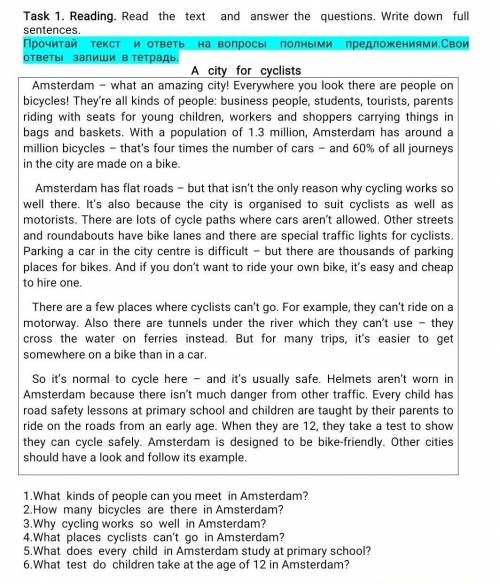
Read the text and answer the questions. Write down full sentences. Прочитай текст и ответь на вопросы полными предложениями.Cвои ответы запиши в тетрадь. A city for cyclists Amsterdam – what an amazing city! Everywhere you look there are people on bicycles! They’re all kinds of people: business people, students, tourists, parents riding with seats for young children, workers and shoppers carrying things in bags and baskets. With a population of 1.3 million, Amsterdam has around a million bicycles – that’s four times the number of cars – and 60% of all journeys in the city are made on a bike. Amsterdam has flat roads – but that isn’t the only reason why cycling works so well there. It’s also because the city is organised to suit cyclists as well as motorists. There are lots of cycle paths where cars aren’t allowed. Other streets and roundabouts have bike lanes and there are special traffic lights for cyclists. Parking a car in the city centre is difficult – but there are thousands of parking places for bikes. And if you don’t want to ride your own bike, it’s easy and cheap to hire one. There are a few places where cyclists can’t go. For example, they can’t ride on a motorway. Also there are tunnels under the river which they can’t use – they cross the water on ferries instead. But for many trips, it’s easier to get somewhere on a bike than in a car. So it’s normal to cycle here – and it’s usually safe. Helmets aren’t worn in Amsterdam because there isn’t much danger from other traffic. Every child has road safety lessons at primary school and children are taught by their parents to ride on the roads from an early age. When they are 12, they take a test to show they can cycle safely. Amsterdam is designed to be bike-friendly. Other cities should have a look and follow its example.
1.What kinds of people can you meet in Amsterdam? 2.How many bicycles are there in Amsterdam? 3.Why cycling works so well in Amsterdam? 4.What places cyclists can’t go in Amsterdam? 5.What does every child in Amsterdam study at primary school? 6.What test do children take at the age of 12 in Amsterdam?
Skills Time! Lesson Five
Reading
Order the letters and write the words.
1. Fireworks burst above the stadium. (rusbt)
Solution: The correct word is "burst" because it matches the given letters (rusbt) and makes sense in the given context. Fireworks burst above the stadium.
2. The cymbals are like two metal plates. (y cmisab)
Solution: The correct word is "cymbals" because it matches the given letters (y cmisab) and makes sense in the given context. Cymbals are like two metal plates.
3. When the school concert finishes, we pack our instruments. (up capk)
Solution: The correct word is "pack" because it matches the given letters (up capk) and makes sense in the given context. When the school concert finishes, we pack our instruments.
4. The lights shine on the stage when the band is playing. (enhis)
Solution: The correct word is "shine" because it matches the given letters (enhis) and makes sense in the given context. The lights shine on the stage when the band is playing.
5. The people in the orchestra play lots of instruments. (rastorhce)
Solution: The correct word is "orchestra" because it matches the given letters (rastorhce) and makes sense in the given context. The people in the orchestra play lots of instruments.
6. Jim went to a pop concert. It was a treat after passing his exams. (artet)
Solution: The correct word is "treat" because it matches the given letters (artet) and makes sense in the given context. Jim went to a pop concert. It was a treat after passing his exams.
7. After each piece, the audience clapped. (epiec)
Solution: The correct word is "piece" because it matches the given letters (epiec) and makes sense in the given context. After each piece, the audience clapped.
I hope this helps! Let me know if you have any other questions.
1) You mustn't drive on the pavement. It's illegal. (Mustn't is used to express prohibition or a strong obligation not to do something.)
2) You shouldn't say that. It's not nice. (Shouldn't is used to give advice or express a suggestion about what is the right or best thing to do.)
3) He must have gone out. (Must have is used to express a deduction or a strong belief about something that happened in the past.)
4) You should eat more vegetables. They're good for you. (Should is used to give advice or express a suggestion about what is the right or best thing to do.)
5) You must be 18 before you can buy alcohol. (Must is used to express a strong obligation or necessity.)
6) Boys and girls, you must hand in your essays by Thursday. (Must is used to express a strong obligation or necessity.)
Explanation:
1) It is stated that driving on the pavement is illegal, so it is important to use the modal verb mustn't, which expresses prohibition or a strong obligation not to do something.
2) It is mentioned that saying something is not nice, so the modal verb shouldn't is used to give advice or express a suggestion about what is the right or best thing to do.
3) It is indicated that he is not here, so the deduction is made that he must have gone out. "Must have" is used to express a deduction or a strong belief about something that happened in the past.
4) It is mentioned that vegetables are good for health, so the modal verb should is used to give advice or express a suggestion about what is the right or best thing to do.
5) It is stated that a person needs to be 18 before buying alcohol, so the modal verb must is used to express a strong obligation or necessity.
6) The students are being instructed to hand in their essays by Thursday, so the modal verb must is used to express a strong obligation or necessity in this situation.
0,0(0 оценок)
Полный доступ
Позволит учиться лучше и быстрее. Неограниченный доступ к базе и ответам от экспертов и ai-bota
Оформи подписку