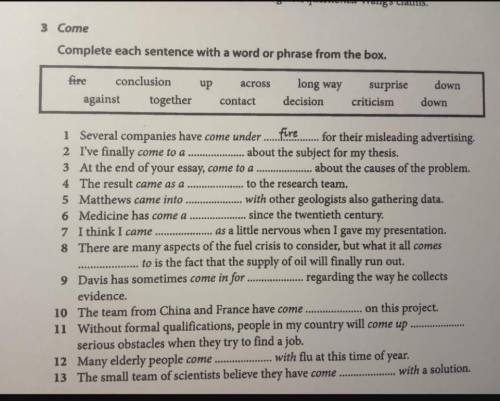
3 Come Complete each sentence with a word or phrase from the box. fire conclusion up across contact long way decision surprise criticism down down for their misleading advertising. the subject for my thesis. against together 1 Several companies have come under fire 2 I've finally come to a about 3 At the end of your essay, come to a about the causes of the problem. 4 The result came as a to the research team. 5 Matthews came intowith other geologists also gathering data. 6 Medicine has come a since the twentieth century. 7 I think I cameas a little nervous when I gave my presentation. 8 There are many aspects of the fuel crisis to consider, but what it all comes to is the fact that the supply of oil will finally run out. 9 Davis has sometimes come in for regarding the way he collects evidence. 10 The team from China and France have come on this project. 11 Without formal qualifications, people in my country will come up serious obstacles when they try to find a job. 12 Many elderly people comewith flu at this time year. 13 The small team of scientists believe they have comewith a solution. ПРОСТО ПИШИТЕ 1 СЛОВ 2 СЛОВО 3 СЛОВО И Т.Д.
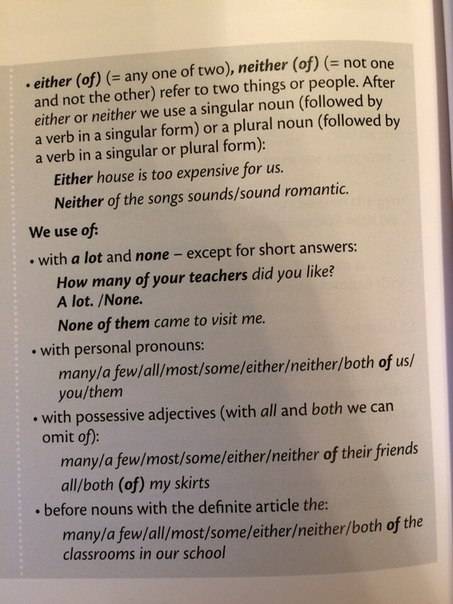
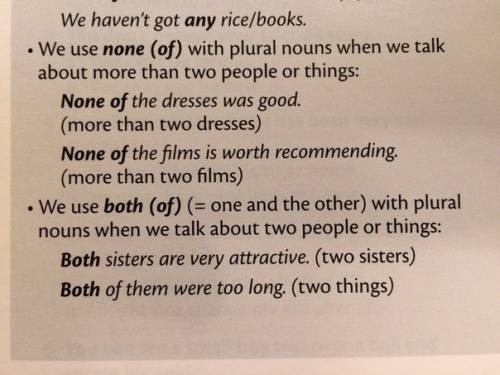
В общем, нашла кое-что в Click On 2, но это, как я понимаю, не то, но всё-таки посмотри на фотках.
Из моей методички: Отрицание В английском языке только одно отрицание. Поэтому в предложении, содержащем слова: never, nobody, nothing, neither, none, none of smb сказуемое употребляется в утвердительной форме(+)
I'm never late for my classes None of us were upset I like neither coffee nor tea
"Тоже" 1) too (в утвердительном и вопросительном предложениях) I like music. My friends like music too.
2) So + вс модальный глагол + подлежащее I like music. So do my friends. I've always wanted it to happen. So have my friends. I were drunk. So were my friends. I must go. So must we И ТАК СО ВСЕМИ МОДАЛЬНЫМИ ГЛАГОЛАМИ И СО ВСЕМИ ВРЕМЕНАМИ.
"Тоже НЕ" 1) сказуемое в отрицательной форме either I'm not afraid of dogs either.
2) neither + вс модальный глагол + подлежащее I don't speak English. Neither do my friends I've never wanted it to happen. Neither have my friends. I couldn't come. Neither could my friends.
БОНУС: I go neither to the cinema nor to the theatre. ( Не хожу ни в кино, ни в театр) I don't go either to the cinema or to the theatre. ( Не хожу ни в кино, ни в театр) Два разных сказать одно и то же. Обрати внимание на частицы or и nor, их нельзя путать
Сan- модальный глагол в Present(в настоящем времени). Сould-модальный глагол в Past(в времени).Could используют для выражения возможности что-то сделать. Would-модальный глагол в выражает значение вежливого побуждения(в или предложения чего-то) или в придположениях. Примери: 1)I can draw a hourse-Я могу нарисовать дом. 2)I can*t draw a hourse-Я не могу нарисовать дом. Сould: 1)I couldn*t understand him-Я не мог его понять. 2)I could understand him-Я мог его понять. Would: 1)Would you open the door please?-Не могли бы вы открыть дверь? 2)Would you like tea or juice?-Не хотите вы чай или сок? 3)Oh that would be his son-Это наверно его сын.
0,0(0 оценок)
Полный доступ
Позволит учиться лучше и быстрее. Неограниченный доступ к базе и ответам от экспертов и ai-bota
Оформи подписку