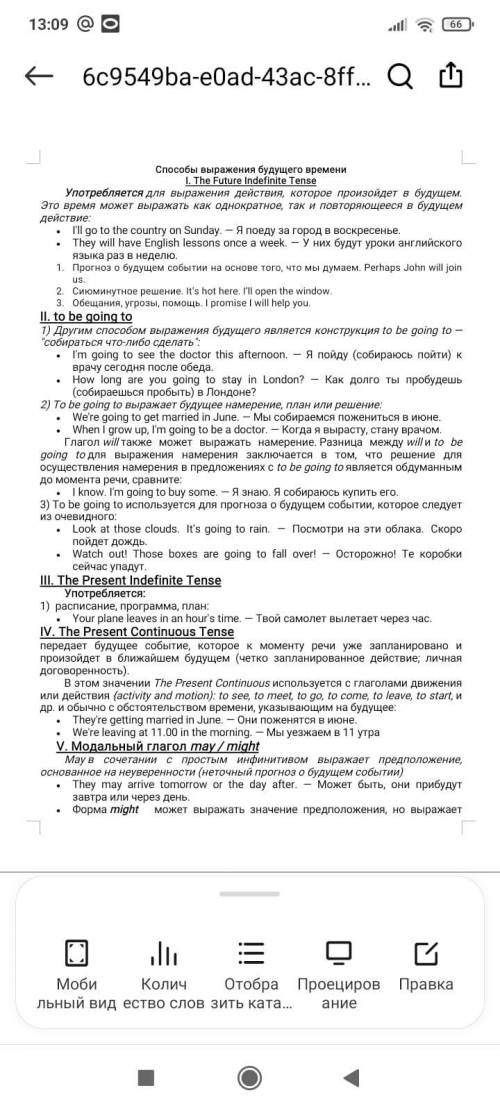
Ways of Expressing the Future Tense I. The Future Indefinite Tense It is used to express an action that will happen in the future. This time can express both a single and repeated action in the future: • I'll go to the country on Sunday. - I'm going out of town on Sunday. •They will have English lessons once a week. - They will have English lessons language once a week. 1. Forecast about the future event based on what we think. Perhaps John will join us. 2. A momentary solution. It's hot here. I'll open the window. 3. Promises, threats, help. I promise I will help you. II. to be going to 1) Another way of expressing the future is the construction to be going to - "going to do something": • I'm going to see the doctor this afternoon. - I'm going (going to go) to the doctor this afternoon. How long are you going to stay in London? - How long will you stay (are you going to stay) in London? 2) To be going to expresses a future intention, plan or decision: • We're going to get married in June. - We are going to get married in June. • When I grow up, I'm going to be a doctor. - When I grow up, I will become a doctor. The verb will can also express intent. The difference between will and to be going to for the expression of intention is that the decision to implement the intention in sentences with to be going to is deliberate until the moment of speech, compare: • I know. I'm going to buy some. - I know. I'm going to buy it. 3) To be going to is used to predict a future event, which follows from the obvious • * Look at those clouds. It's going to rain. - Look at these clouds. It's going to rain soon. Watch out! Those boxes are going to fall over! - Careful! Those boxes are about to fall. III. The Present Indefinite Tense Used: 1) schedule, program, plan: • Your plane leaves in an hour's time. - Your plane departs in an hour. IV. The Present Continuous Tense conveys a future event that is already planned by the time of the speech and will happen in the near future (clearly planned action; personal agreement). In this sense, The Present Continuous is used with verbs of movement or action {activity and motion): to see, to meet, to go, to come, to leave, to start, etc. and usually with a circumstance of time indicating the future: They're getting married in June. - They're getting married in June. • We're leaving at 11.00 in the morning. - We leave at 11 a.m. V. Modal verb may/might Mau in combination with a simple infinitive expresses an assumption based on uncertainty (an inaccurate forecast about a future event) They may arrive tomorrow or the day after. - Maybe they will arrive tomorrow or the next day. * The might form may express the meaning of the assumption, but expresses Moby Number of The selection of the projected Edit the visual appearance of the words zit kata... ta… current
1) “We’ve definitely made mistakes, but it’s probably the first time in our lives that we’re not getting a grade and we don’t have anyone telling us what to do.” 2) Lehigh first tried what it calls its mountaintop program on a smaller scale last summer, combining elements that scholars of education have advocated for years — research, work experience and independent, long-form projects. 3) Some colleges have expanded those practices, but the going has been slow. 4) The annual National Survey of Student Engagement shows that by the time they graduate, fewer than half of college students have done internships or some other kind of field experience, fewer than half have done a senior thesis and just 23 percent have done research with a faculty member outside of what is required for their courses.
Present Continuous.
1) Most of the students here are pursuing their own projects — about 30 in all — and finding their own way, with little faculty input and with nothing more at stake than testing their own ambition, skills and curiosity. 2) “We got a group together and said what we wanted to do, and the administration just said, ‘O.K., ask for any equipment or advice you need,’ ” said Colleen Perry, who is studying bioengineering. 3) “We’ve definitely made mistakes, but it’s probably the first time in our lives that we’re not getting a grade and we don’t have anyone telling us what to do.” 4) So what Lehigh is trying, she said, “is pretty interesting.”
Present Perfect Continuous.
“We know that these are high-impact practices that we’ve been expanding, but we need to think about new models of how to promote them, because a faculty member can only take on so many students to mentor directly,” said Lynnette Overby, director of undergraduate research and experiential learning at the University of Delaware.
3. Найдите и выпишите предложения в Present Perfect. --- “We’ve definitely made mistakes, but it’s probably the first time in our lives that we’re not getting a grade and we don’t have anyone telling us what to do.” --- Lehigh first tried what it calls its mountaintop program on a smaller scale last summer, combining elements that scholars of education have advocated for years — research, work experience and independent, long-form projects. --- Some colleges have expanded those practices, but the going has been slow. --- The annual National Survey of Student Engagement shows that by the time they graduate, fewer than half of college students have done internships or some other kind of field experience, fewer than half have done a senior thesis and just 23 percent have done research with a faculty member outside of what is required for their courses.
4. Найдите и выпишите предложения в Present Continuous. --- Most of the students here are pursuing their own projects — about 30 in all — and finding their own way, with little faculty input and with nothing more at stake than testing their own ambition, skills and curiosity. --- “We got a group together and said what we wanted to do, and the administration just said, ‘O.K., ask for any equipment or advice you need,’ ” said Colleen Perry, who is studying bioengineering. --- “We’ve definitely made mistakes, but it’s probably the first time in our lives that we’re not getting a grade and we don’t have anyone telling us what to do.” So what Lehigh is trying, she said, “is pretty interesting.”
5. Найдите и выпишите предложения в Present Perfect Continuous. --- “We know that these are high-impact practices that we’ve been expanding, but we need to think about new models of how to promote them, because a faculty member can only take on so many students to mentor directly,” said Lynnette Overby, director of undergraduate research and experiential learning at the University of Delaware.
0,0(0 оценок)
Полный доступ
Позволит учиться лучше и быстрее. Неограниченный доступ к базе и ответам от экспертов и ai-bota
Оформи подписку