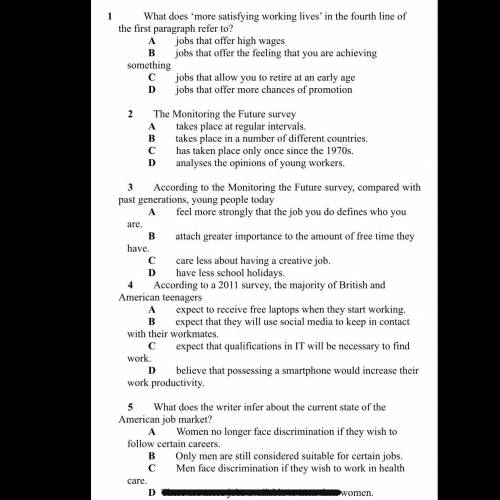
HOW DO TEENAGERS SEE THEIR FUTURE WORKING LIVES? In a fast-changing world, what are young people’s hopes and expectations for their careers? The answer, according to a study that spans the generations, seems to be less busy but more satisfying working lives than their parents’.
Thousands of American students have been questioned about their attitudes for the Monitoring the Future survey every 15 years since the 1970s. The most recent results suggest that work is of less importance to the young people of today than the youth of the past, because they value leisure time more. The number of young people who said it was “very important” to have a job with more than two weeks’ paid holiday in the 2000s was double the number who said so in the 1970s. Three quarters of people born in the 1950s and 1960s said they expected work to be a central part of their lives, but only 63% of people born three decades later said the same. There was a higher percentage, however, of people who wanted to have a creative job in the 2000s – 41%, as opposed to 36% of the 1970s participants.
A separate survey has revealed teenagers’ faith in IT to help them to perform work-related tasks. In 2011 around 300 British and American 16 to 18-year-olds were questioned about what technology they expect their future employers to provide them with. About 70% agreed that a smartphone would make it easier to do their work – and a quarter said they expected one to come with their job. About 40% saw themselves getting a laptop from their future employers. Perhaps more surprisingly, nearly half expected to use social media for communicating with their colleagues, and nearly 10% expected to use it to deal with their bosses.
So what exactly would these creative, techno-savvy teenagers like to do for a living? A recent survey of American teenagers found that the arts and medicine were the most popular career paths, with 17% of teenagers expressing an interest in each. The next most popular choice was engineering. The least popular career choices included science (9%) and business (8%). Despite all careers being open to both sexes in the US, differences remain between boys’ and girls’ aspirations. A quarter of girls were interested in working in healthcare in some way, compared with only 9% of boys, while only 4% of girls wanted to be engineers, compared with 25% of boys.
Disclaimer: This work has been submitted by a student. This is not an example of the work written by our professional academic writers. You can view samples of our professional work here.
Any opinions, findings, conclusions or recommendations expressed in this material are those of the authors and do not necessarily reflect the views of UK Essays.
Published: Mon, 5 Dec 2016
Money is the biggest motivator of people at the workplace. Most people are motivated by money. According to Alison Griffiths, journalist of Metro Canada, survey showed that 53 percent of Baby Boomers in Canada did want to earn more money while 32 percent of them did plan to open a own business after retirement to earn more money too. Besides that, Reuters (2012) also stated that 31.4 percent of Americans aged from 65 to 69 were still working in year 2010, compared to year 1990 with a lower percentage which is 21 percent. These showed that Baby Boomers value money as an important motivation factor. For example, A Generation X employee tells a Boomer manager that he had been working too hard and request for taking an off for family vacation. Instead of saying thanks, the Boomer replies, “I work to get ahead, to get a promotion, not for a vacation.” The Boomer manager then gave the employee a bonus, rather than a vacation (Hammill, G., 2005). In contrast, Generation X seek a work-life balance where they will take less money if they are given opportunity to work lesser hours and have time off to spend with family or take a vacation. For them, money act as an incentive or reward but it does not add value to the job. Whilst, Boomers are attracted to position and even more money rather than placing value on vacation time or flex time. According to Mcshane (2010), Generation X and Generation Y employees expect a more egalitarian workplace. For them, money is an important factor but it is not a standalone. A study by Accenture consulting firm found that 50% of middle managers were interested in new job that provide benefits such as more time off rather than more pay (Williams, R., 2010) Thus, money is very important to employees for number of reasons. I firmly believe that money is the major and biggest motivator at the workplace. Some of the motivation theory model also explains the importance of money as a major motivator factor such as Maslow’s Needs Hierarchy Theory, ERG Theory, Equity Theory and etc.
The current Olympiad is the thirtieth. But this is a modern Olympiad. Antique Olympic games were held about three hundred times! Do you know what happened to this sports festival then, in the year 394? Olympiad strangely fell into the category of pagan rites! And with a slight movement of the hand of the Roman emperor Theodosius the First, the Olympic Games were covered for one and a half thousand years. 02. But even then, in the 19th century, the idea to resume the Olympic Games on an antique model was met with very skepticism - it was not clear where to get money from, how to choose decent ones, and so on. As a result - a useless organization, poor discipline of athletes and judges, and the constant change of sports. What they were just not a hundred years ago - they jumped from a place in height, swam between logs and boats, pulled the rope, played cat and mouse ... No, it did not come to cat and mouse, but everything else was fun and easy. 03. By the way, the first General Secretary of the International Olympic Committee, Baron Pierre de Coubertin, saw the modern Olympic Games as competitions of amateur sportsmen only. And even the trainers worked exclusively for the idea. American Jim Thorpe in 1913, even deprived of all titles and medals, when they learned that he played baseball - oh, horror! - for money. By the way, Thorp took part in other competitions, about ten kinds of sports in total, which also perfectly characterizes the Olympiad of a hundred years ago. 04. On the other hand, a bad amateur who does not dream of becoming a professional. Recall at least Eric Musambani Malong from Equatorial Guinea. Journalists from The Times gave him the nickname Eric Eel after he gave the worst scapegoat in the whole history of the Olympic Games in Sydney. The fact is that the Guinean - a) swam a hundred meters for the first time in his life, b) he also saw the 50-meter pool for the first time and, finally, c) learned to swim 8 months before the competition. How did such an eel seeped into the Olympics? And there is, it turns out, a special quota for developing countries. Truly, not victory is important, but participation! By the way, Eric is still lucky.
0,0(0 оценок)
Полный доступ
Позволит учиться лучше и быстрее. Неограниченный доступ к базе и ответам от экспертов и ai-bota
Оформи подписку