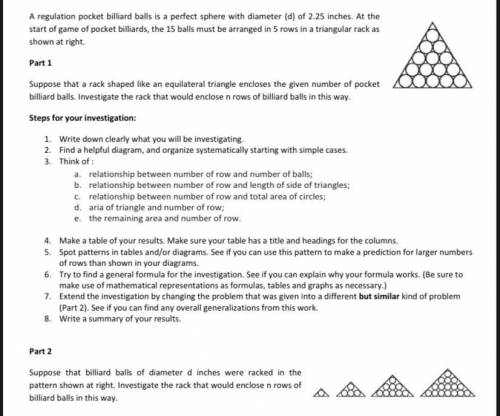
A regulation pocket billiard balls is a perfect sphere with diameter (d) of 2.25 inches. At the start of game of pocket billiards, the 15 balls must be arranged in 5 rows in a triangular rack as shown at right. Part 1 Suppose that a rack shaped like an equilateral triangle encloses the given number of pocket billiard balls. Investigate the rack that would enclose n rows of billiard balls in this way. Steps for your investigation: 1. Write down clearly what you will be investigating. 2. Find a helpful diagram, and organize systematically starting with simple cases. 3. Think of: a. relationship between number of row and number of balls; b. relationship between number of row and length of side of triangles; C. relationship between number of row and total area of circles; d. aria of triangle and number of row; e. the remaining area and number of row. 4. Make a table of your results. Make sure your table has a title and headings for the columns. 5. Spot patterns in tables and/or diagrams. See if you can use this pattern to make a prediction for larger numbers of rows than shown in your diagrams. 6. Try to find a general formula for the investigation. See if you can explain why your formula works. (Be sure to make use of mathematical representations as formulas, tables and graphs as necessary.) 7. Extend the investigation by changing the problem that was given into a different but similar kind of problem (Part 2). See if you can find any overall generalizations from this work. 8. Write a summary of your results. Part 2 Suppose that billiard balls of diameter d inches were racked in the pattern shown at right. Investigate the rack that would enclose n rows of billiard balls in this way.
Вычислить площадь фигуры, ограниченной линиями: y = 1/(1+cos(x)) ; y = 0; x =+-Pi/2. В начале преобразуем функию (1+cosx)/2 =cos^2(x/2) Поэтому 1+cosx=2cos^2(x/2) y=1/(1+cos(x)) =1/(2cos^2(x/2)) Находим площадь фигуры S = интегр [от x1=-пи/2 до x2 =пи/2](1/(1+cos(x))dx = = интеграл [от x1=-пи/2 до x2= пи/2](1/(2cos^2(x/2)))dx= = интеграл[от x1=-пи/2 до x2= пи/2](1/cos^2(x/2))dx/2= замена переменных у=x/2 пределы от y1=-пи/4 до y2=пи/4 = интеграл[от y1=-пи/4 до y2 пи/4] (1/cos^2(у))dу= =tg(y)[от y1=-пи/4 до y2=пи/4] =tg(пи/4)-tg(-пи/4) = 1-(-1)=2 ответ: S=2
1) 320 х 0,45 = 144 уч. учат 1 главу 2) 320 х 0,25 = 80 уч. учат 1 главу 3) 320 х 0,15 = 48 уч. учат 2 главу 4) 320 х 0,1 = 32 уч. учат 2 главу 5) Х уч. учат 3 главу. Х =320 -144-80-48-32; Х = 16 (учеников). Делю учеников по классам: изучающих 1 главу (144+ 80 = 124 уч) изучающих 2 главу ( 42 + 32 = 74 уч) изучающих 3 главу ( 16 уч) Т.к. в каждом классе должно быть максимум 40 учеников, должно быть классов (320 : 40) = 8 (классов). Узнаю, сколько учеников, изучающих разные главы одновременно должно быть в одном классе: Изучающих 1 главу: (144+80) : 8 = 28 (учеников) Изучающих 2 главу: (48 + 32) : 8 = 10(учеников) Изучающих 3 главу : (16:8) = 2 ученика. Проверяем, ск учеников получилось в одном классе: 28+10+2=40(учеников). Условие задачи соблюдено. ответ: 8 классов потребуется для того, чтобы позволить изучать математику каждому классу одновременно
0,0(0 оценок)
Полный доступ
Позволит учиться лучше и быстрее. Неограниченный доступ к базе и ответам от экспертов и ai-bota
Оформи подписку