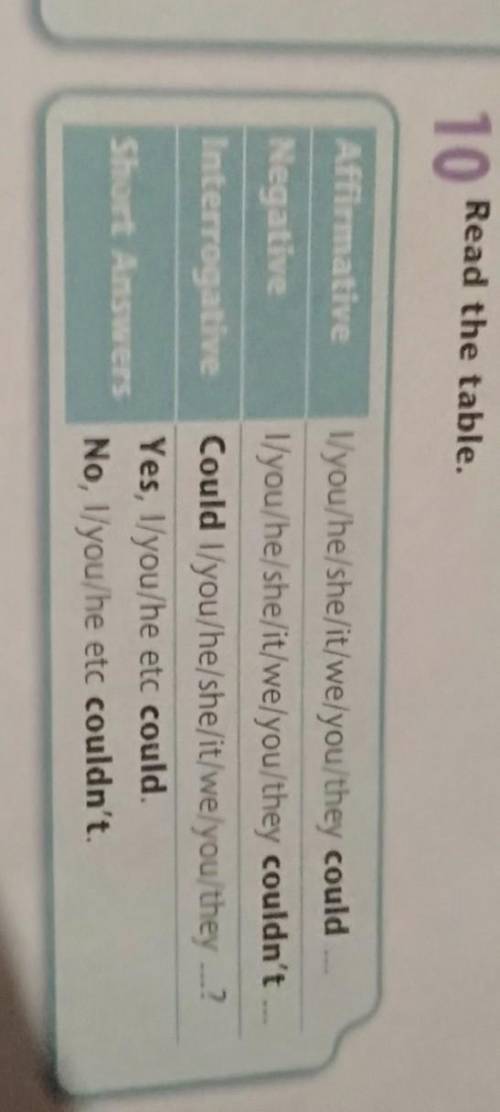
10 0 Read the table. Affirmative Negative Interrogative W/you/he/she/it/we/you/they could Il you/he/she/it/we/you/they couldn't ... Could I you/he/she/it/we/you/they ...? Yes, you/he etc could No, I you/he etc couldn't Start Answers
+ 1. Alice has a sister. 2. Her sister’s name is Ann. 3. Ann is a student. 4. She gets up at seven o'clock. 5. She goes to the institute in the morning. 6. Jane is fond of sports. 7. She does her morning exercises every day. 8. For breakfast she has two eggs, a sandwich and a cup of tea. 9. After breakfast she goes to the institute. 10. Sometimes she takes a bus. - 1. Alice hasn't a sister. 2. Her sister’s name isn't Ann. 3. Ann isn't a student. 4. She does not get up at seven o'clock. 5. She does not go to the institute in the morning. 6. Jane isn't fond of sports. 7. She does not do her morning exercises every day. 8. For breakfast she hasn't two eggs, a sandwich and a cup of tea. 9. After breakfast she does not go to the institute. 10. Sometimes she does not take a bus.
И так сначала идёт вопросительное слово, а потом вс глагол, местоимение или имя, глагол и так далее. например What are you doing tonight? иногда в вопросах не бывает вс глагола поэтому вот второй пример Do you like chocolate? А ответы формируются по вопросам. Например Yes, I do/ No, I don't (don't =do not утверждает что нет ) это ответ на второй вопрос. На английском это называется yes no questions то есть вопросы на которых отвечают да или нет А ответ на первый вопрос это просто предложение например I am going to do my homework
0,0(0 оценок)
Полный доступ
Позволит учиться лучше и быстрее. Неограниченный доступ к базе и ответам от экспертов и ai-bota
Оформи подписку